Touring Tassie
|
|
|


|
Tasmania has some of the most beautiful landscapes
in Australia. We would have been very foolish to miss seeing at least some of
the island away from the coast. We set off in a hired car for a seven day
swing around the Island State. Wherever we went, Vicky had hikes planned
along the way, sometimes through the wilds and at others along well kept
boardwalks and tracks. Our accommodation varied from the spartan to the cosy.
However, for the most part we were at least comfortable, if not always warm.
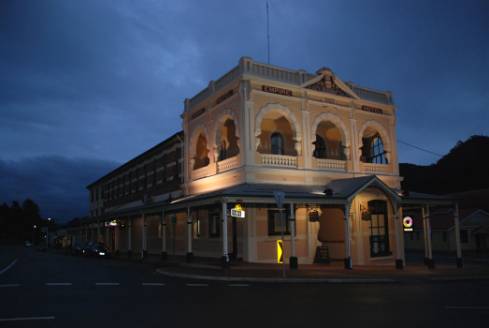
The Empire Hotel in the mining town of Queenstown looked a great deal grander
on the outside than its rooms were inside. |
|
|
|
One of the highlights of the trip was our
visit to Cradle Mountain National Park. Fortunately for Tom, the path to Cradle
Mountain itself was closed, but that up Hanson Peak was quite challenging
enough in parts. While the view from the top over Dove Lake and toward Cradle
Mountain was spectacular enough to compensate for the scramble up the scree. |
|


|
|
If it hadn’t been, our return journey on a
track through the Twisted Lakes, would have made up for a lot. The alpine
scenery was beautiful, the sky clear and the air just warm enough. It was
perfect hiking weather through perfect hiking country. We thoroughly enjoyed
it. By the end we felt somewhat fitter – certainly
fitter than the chubby pademelon (a kind of miniature wallaby), which sat
hopefully, but fruitlessly, outside our cabin that evening. |
|


|
|
|


|
Unable to stay away from the coast, the
next day we drove to Stanley, near the northwestern corner of Tassie. It is a
small village, old by Australian standards and therefore preserved as
something of a historical artefact. It was a pretty place and pleasantly
devoid of tourists at this off-season time. We hiked up the ‘Nut’, the large
lump of rock which dominates the village, and were surprised by how varied
the landscape was on it’s flat top. We spent a comfortable night at the
Stanley Hotel. |
|
|
|
|
A drive through the rich, red farmland
around Burnie brought us back along the North coast to the river Tamar. Here
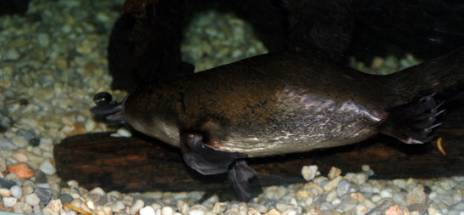
we first visited Platypus House. We had hoped previously to spot one of these
unusual animals in the wild, but they are notoriously shy and hard to see, so
we were reduced to seeing them in captivity. As in some zoos, there was good
reason to keep them, as the wild population of Tasmania is being attacked by
disease and dying off. In any case, it was a fascinating opportunity to see
and learn about these egg-lying mammals. |

|
Our most stylish accommodation was at the
Fitzpatrick Inn in Westbury. Ironically, it was purely by chance that we
ended spending two nights there, as we had planned to stay in Deloraine.
However, the hotels in the latter looked really shabby and the whole town was
unattractive. We turned snooty and luckily found ourselves at the Fitzpatrick
Inn, which dates from the 1830’s, though the inside was much modernised. It
proved an excellent base from which to tackle our next challenges. The Western Tiers form an escarpment
running across central Tasmania, with a wide plateau on the top. As you might
expect, the escarpment itself is pretty steep. An hour and a quarter of
steady hiking up the steep track brought us to the top and onto the plateau,
where we were surprised to find a hut, built by volunteers from the local
hikers club. |
|

|
|
|


|
|
|
|
|
A further 20 minutes across the boggy
plateau into a stiff, cold breeze brought us to the shore of Lady Lake,
Vicky’s morning goal. The trip back down was harder on the knees than the
climb up. |


|
|
With a clear, bright day, Vicky couldn’t resist
a further lengthy swing through the Tiers – fortunately this time by car –
for more photo opportunities. To round the day off, despite the late
hour, the encroaching dark and an almost empty fuel tank we drove to Liffey
Falls, jogged a mile down the track to get just a few more photos and then
jogged back, hoping against hope that we might still find petrol stations
open on the way back to the Fitzpatrick Inn. We did – and slept very soundly
after the day’s exertions. Of course, the following morning it was
essential to rise early in order to catch the best light – for photography –
at the Cataract Gorge in Launceston. The light was good and the Cataracts attractive,
as was the whole town, having rather more character visually than Hobart,
however much the natives of the latter may look down their noses on their
northern sister. The Victorian and Edwardian architecture was well preserved,
as were some even older buildings. The pedestrian, suspension bridge across
the Cataracts was especially elegant. To complete our bridge viewing we stopped
at Ross, on the way back to Hobart the next day. There we found the
contrasting Georgian simplicity and solidity of the Ross Bridge. |

|
|
|
|
|


|
|
|


|
|
On our return to ‘Sunstone’ we guiltily
took up where we had left off on maintenance, Tom even going so far as to
build three new dorade boxes to replace those, which, after 42 years service
were finally looking for retirement. |
|


|
|
After careful researches we managed to
discover a treasure trove of Ocean Cruising Club members in the Hobart area
and organised a small get-together at the DSS. Interestingly, several of the
members had not previously met, despite the best efforts of Port Officer,
John Solomon and former Roving Rear-Commodore Hugh Garnham. Both John and
Hugh did a great deal to make our stay in Hobart a thoroughly enjoyable one. |

|
With only a couple of weeks to go before
we hoped to head away toward New Zealand, we felt that ‘Sunstone’ really
deserved another race fix – and so did we. With the able assistance of the ‘Lock
on Wood’ crew, as well David Pryce from ‘Blizzard’, we had a delightful sail
in perfect early spring weather. It could not have been a better way to
remember Hobart. |
|
|
|

