SEWARD AND PRINCE WILLIAM SOUND
|
Seward
is on the Kenai Peninsula some 170 miles northeast of Kodiak Island. It was our second visit to this town of
3,000 people, where two huge 'blocks of flats' – that means cruise ships –
daily tie up in the summer, more than doubling the population. It is a tourist venue, situated up
picturesque Resurrection Bay, surrounded by mountains, with glaciers, hiking
opportunities, fishing and wildlife-viewing all close-by; and it is about a
two hour drive by car from Anchorage, the largest city in Alaska. |
|
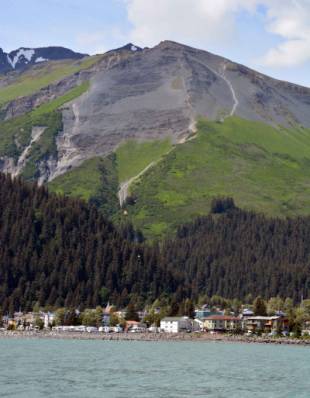
On our first visit in 2002 we arrived in early July and we had planned this second visit at the same time. We wanted to be in Seward for American Independence Day, 4 July, to coincide with the town's celebrations. Dominating the view in Seward is the towering 3,022 ft (921m) peak of Mount Marathon. On the 4 July it is the focus of a running race; up to the summit and down again. The lower half of Mount Marathon is tree-clad, rock and scree cover the top half. The 4 July Parade with floats and flag-waving takes place in the middle of the day, but before and after that, the main feature is the run for women and then for the men. |
|
|
|
All
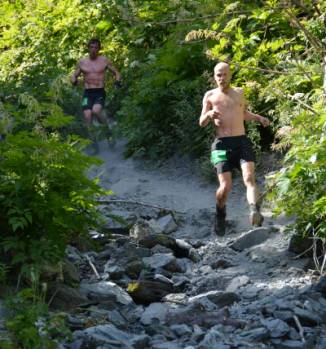
runners are a bit crazy, but these runners are downright mad. The challenge requires a daunting effort
that takes runners through thick tree cover with roots and soft slippery
earth, up some sixty degree slopes, over rocks, boulders and scree, sometimes
with snow, often intensely slippery and always ready to push runners over the
edge, with cuts, bruises and sometimes broken limbs. In 2002 we had climbed this mountain, Tom
half way, Vicky to the top. It was a
strenuous hike; three hours round trip.
The runners have mind-blowing times.
The woman's record set in 1990 is 50:30; for the men, 42:55 set in
2013. That is 33 minutes up and 10
minutes for the unbelievably quick slide cum run down. |
|
Seward
is a yachting centre, catering for the vast majority of Alaska's sailing
boats. There is even a small Yacht
Club. We soon got talking to other
sailors along the dock, were invited to two pot-luck parties and were even
remembered by past friends from our visit twelve years ago! It is probably not that we are so
distinguished as that we have a distinguishable yacht! A
long day motor-sail brought us into Prince William Sound. For us, this nearly enclosed body of
water, some 90 miles wide and 70 miles north-south is the jewel of Alaskan
cruising. We loved the place in 2002
and we loved it again in 2014. Here
we reached our furthest north on this cruise in Barry Arm, latitude 61:06'.
There are numerous anchorages through the Sound, the wildlife is abundant,
fishing excellent, with many glaciers, including a number of tide-water
glaciers that are reasonably accessible up close by a yacht. Some of the anchorages are deep however,
with 25-30m not uncommon. We said
before everything in Alaska is big – including the depths! |
|
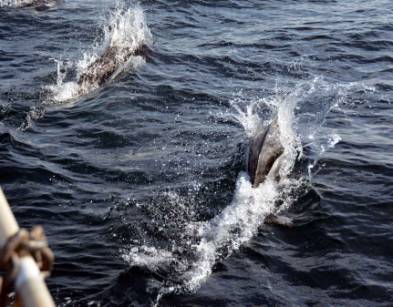
By the end of the first day in the Sound we had seen humpbacks feeding and sounding, sea otters eating a supper of molluscs on their chests, curious harbor seals, playful Dall's porpoises, a black bear and more bald eagles. That was a good day for the wildlife and it was sunny. Then it rained – heavily for two and half days. We holed up in Whittier, at the western end of Prince William Sound, where rain is a constant feature of life, some 16' every year. But then as Dolly Parton quipped; "The way I see it, if you want the rainbow, you gotta put up with the rain." We had to and did. |
|
|
The
Lonely Planet Guide for Alaska starts off its description of Whittier saying;
"... you will never, in a lifetime of searching, find another place
quite like Whittier." Early on
Native Indians lived near here; then gold-seekers came, fur traders and
explorers. However a permanent
population only came during the Second World War, when the US began looking
for a spot to build a secret military installation. The proposed base needed to be not only an ice-free port, but
also as inaccessible as possible, lost in visibility-reducing cloud and
surrounded by impassable mountains, so that the Japanese would not find
it. And so, in this place that would
be considered uninhabitable by almost any standard, surrounded by 1,200m
peaks and glaciers, and hung with grey clouds most of the year, Whittier was
built. Most of the current 160 people
live in a single tower block built to house the military. With
the rail tunnel, taking cars from 2000 and visits by cruise ships, Whittier's
tourism has grown. We walked out in
the rain to take in the sights; around the rail yards, past the high rise
building, drinking coffee at a small cafe, watching the cascades grow and
grow and buying a few stores at the small, but well-stocked shop. For other hours on board we read, sorted
digital photos, wrote up our sailing travels and watched movies on the
computer. |
|
|
Three
days later we had a spectacular day – weather and views - bright sun, clear
skies and ice in all its hues from pure white to iridescent blue. The day started with thick fog as we felt
our way out of North Granite Bay with the enclosing granite cliffs just
visible above the low-slung ribbons of swirling grey mist. Out into the more open water of Port Wells
we emerged into the sun with views to the Barry Arm glaciers and up College
Fiord, the huge sweep of Harvard Glacier sliding like a S-bend race track,
from the ice field up near the 4,000 metre peaks into the water. Three
hours later Sunstone was nudging small bergy bits and brash in the
ice-strewn waters up Barry Arm. In
2002 the three glaciers here, Cascade, Barry and Coxe, were joined as one
where they came to the sea. We could
visibly see the recession in those twelve years with rock faces now
separating the three moving flows of ice.
It is almost mesmerising watching ice; with its colour, texture, shape
and sound all giving it a special life.
With Vicky in the dinghy taking photos, Tom gently manoeuvred the boat
around the floating brash and bergy bits.
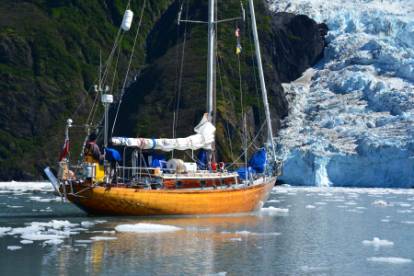
The only vessels that can really sail in ice are steel ones. Ice is both sharp and heavy. We did not want to scratch Sunstone's varnished
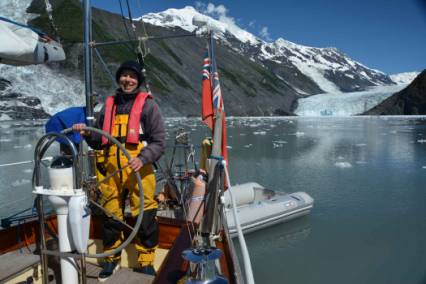
hull or damage the waterline, so moved very slowly. Cascade glacier lived up to its name, growling with a thunderous roar as a falling shower of ice fell off the crevassed ice front. Beside the glaciers the grey/brown rock has been scoured clean from the advancing and then retreating flows of ice. On some slopes there were signs of first growth; sparse patches of mossy-green lichens. A small yacht and her crew seem very insignificant in this wild, large wilderness. The colour contrasts gave our eyes a feast of delights, from the aquamarine water, the white/blue ice, the brown moraine, the grey rock and the green moss, with the azure blue sky above. |
|
|
|
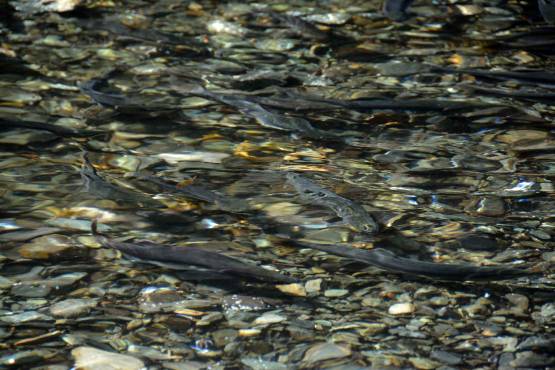
It was a favourite in 2002 and it was a remained so in 2014 – Snug Harbor on Knight Island - one of the many islands in the middle of Prince William Sound. Here it did not matter which direction the wind blew, we would be protected as we swung to our 45lb CQR anchor. Around the bay there are high craggy mountains, a waterfall plummets down from an upper cliff and two streams flow into the head of the bay, with green swards high up, green trees on the cliffs and green grass around the waters edge. One of the streams has returning salmon. The pinks or humpies struggle upstream against the flow, even when there is only about 10mm of water at low tide. They seem to be running not swimming; and we felt as if we could walk on the water, which was so 'thick' with fish. |
|
|
|
Not
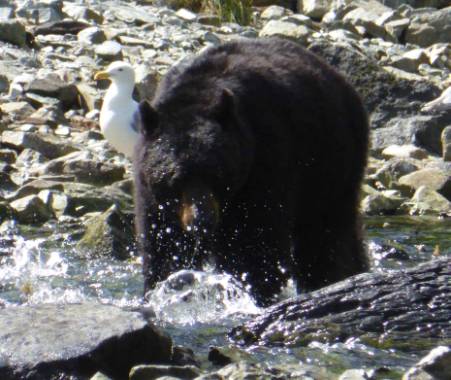
surprisingly such a well-stocked stream attracted a visitor for feeding. We watched a sleek black bear take his
feed of salmon from up the stream as we walked along the gravel shores at low
tide, with the gulls and eagles. The
supply of food for the bear was plentiful and he was choosy. Three times the bear caught a fish with
his paw, the water splashed and he took the fish into his mouth, only to
deposit the catch behind a nearby rock.
The fourth time he was satisfied and wandered off into the sedge grass
to eat his meal. |
|
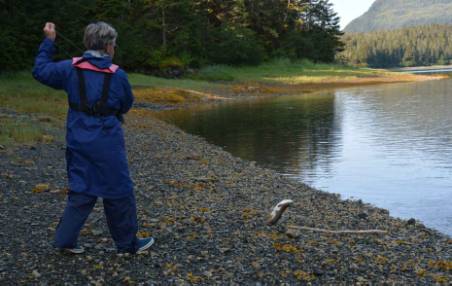
Our salmon fishing was never as successful, although we ate plenty, more by the kindness of fishermen than from our own hand. However, at Snug and again at Olsen Bay, we did manage the easy way to catch salmon – snagging. This must be done in salt water, (not in a stream). With a large, weighted three-pronged hook, you quite literally attempt to snag the fish by throwing the hook near the swimming shoal and dragging it across their bodies, back to the dinghy or beach. When the salmon are 'thick', even novices don’t go hungry! |
|
|
We did not see many other yachts in the Sound, just the occasional fishing boat. With Whittier in the west, there are two other towns; Valdez to the north and Cordova to the east. We have not visited Valdez. It is a large oil port and will be remembered by some when in 1989, the tanker Exxon Valdez struck a reef, spilling 40,000 tons of crude oil into the pristine waters of Prince William Sound. The impact on the wildlife and fishing for the area was huge with devastating losses. For any visitor now there is no visible sign of this disaster and reports would indicate that wildlife numbers have returned to pre-spill populations. |
|
|
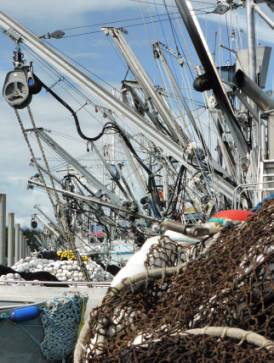
Our penultimate stop in the Sound was the busy fishing
harbour at Cordova. The town with a
population of just over 2,000 is very isolated. There is no road access so people only arrive by boat or
plane. Fishing is the mainstay yet
again and the docks were packed with huge seiners and smaller
gill-netters. The locals were very
friendly and as often happens, its very isolation, creates a community that
is active, concerned and full of spirit.
We know of a number of cruisers who have wintered in Cordova. Despite the wind and snow, they enjoy
themselves engaging in many community activities and those with children have
appreciated the inclusiveness of the schools. |
|
|
We
got to know the proprietor of Orca's Bookshop and Cafe, with a daily
espresso; it was the best place to do Internet. When out cruising we are not connected. For oldies like us, it is possible to live
without instant Internet communication!
But we do like to catch up on e-mails and news when we arrive in a
town. Libraries often have free WiFi,
but in our experience, here in Alaska, the connection is often woefully slow
– you can just about count the bytes as a connection is made. The Orca Cafe gave us reasonable speed, as
we responded to friends' e-mails, looked on Stuff to find out what was big in
New Zealand, caught up on rugby news, or sent an article to one of our many
sailing clubs. When
out in the wilds or on passage on Sunstone we can do e-mails although
we are not connected to the Internet.
We use Sailmail, a boat system set up and run by a boater. We hook up the computer to the SSB radio
and with a special Pactor modem connect to a shore station, if the
propagation is OK. We can then send
e-mails through the radio and receive anything that is in our 'in-box'. It is a simple system, with an annual fee
of US$250, and allows us to keep in touch with relatives and friends just
about anywhere in the world, and we can receive daily weather 'pictures' –
grib files – that give us predictions for the weather in our area for the
coming seven days. Many cruisers now
have sat-phones, but we are perfectly happy with Sailmail. |
|
Our
last stop in Prince William Sound was in Garden Cove, Port Etches, very close
to the Hinchinbrook Channel that would take us out into the Gulf of
Alaska. We keep meeting cruisers we
know, all around the world. There had
been one yacht sharing our anchorage the night before we left. As we prepared to leave Garden Cove, at
0530, 28 July, we saw another that had come in over night. It was Top to Top last seen in
Salinas, Ecuador 2002! They were
asleep and we were on our way – but we did catch up later, further south. We
motor-sailed out through the Hinchinbrook Channel that morning. The wind was light, easterly 7 knots, but
with a very strong tide under us the seas were bubbling. Further offshore to the west we saw large
standing waves, even in such benign conditions. We made a mental note never to come in or go out of this
Channel in strong winds. The sea
conditions would be atrocious. |
|
|
It was a passage of three and half days across the Gulf of Alaska. The wind had been in the east/southeast quadrant all summer, not the best angle for us. We motor-sailed, then had a lumpy beat with rain for 24 hours, before more motor-sailing in calmer, sunny conditions. This gave us the view we had been hoping for. Mount Fairweather 4,670m and Mount Perouse 3,278m, rise up in their snowy glory from the ocean, giving sailors a sparkling backdrop on ‘cloud-failure’ days. |
Next |